
What Is L-Theanine and Why It Matters in Matcha
One amino acid explains most of what makes matcha feel different from every other caffeinated drink — and how much of it ends up in your bowl comes down to how the tea was grown.
L-theanine is an amino acid found almost exclusively in tea plants. It promotes alpha brain wave activity, a state linked to calm, relaxed alertness, and it moderates how caffeine is absorbed — which is why matcha tends to feel like steady focus rather than a sharp spike. Shade-growing the plant for three or more weeks before harvest significantly increases the amount of L-theanine in the leaf, which is why growing method matters as much as the amino acid itself.
What is L-theanine?
L-theanine is an amino acid found almost exclusively in tea plants (Camellia sinensis) — the same plant behind green tea, black tea, and matcha. It doesn't occur in coffee, and it's rare outside of tea at any meaningful concentration. It has no flavor of its own in the way sugar or salt do, but it's closely tied to the umami, savory-sweet quality that high-grade matcha is known for.
L-theanine is a tea-specific amino acid. Coffee simply doesn't have it — which is the starting point for nearly every difference people notice between matcha and coffee.
How it works in the brain
L-theanine is associated with increased alpha brain wave activity — a state linked to calm, relaxed alertness rather than sedation or drowsiness. On its own, it's mildly calming. Paired with caffeine, which every serving of matcha also contains, the effect shifts: L-theanine moderates how the caffeine is absorbed and experienced, softening the sharper, more jittery stimulation caffeine can produce by itself.
This combination is why matcha drinkers commonly describe the feeling as alert without jittery, focused without anxious — a description that shows up so consistently it's become something of a shorthand in how matcha is talked about.
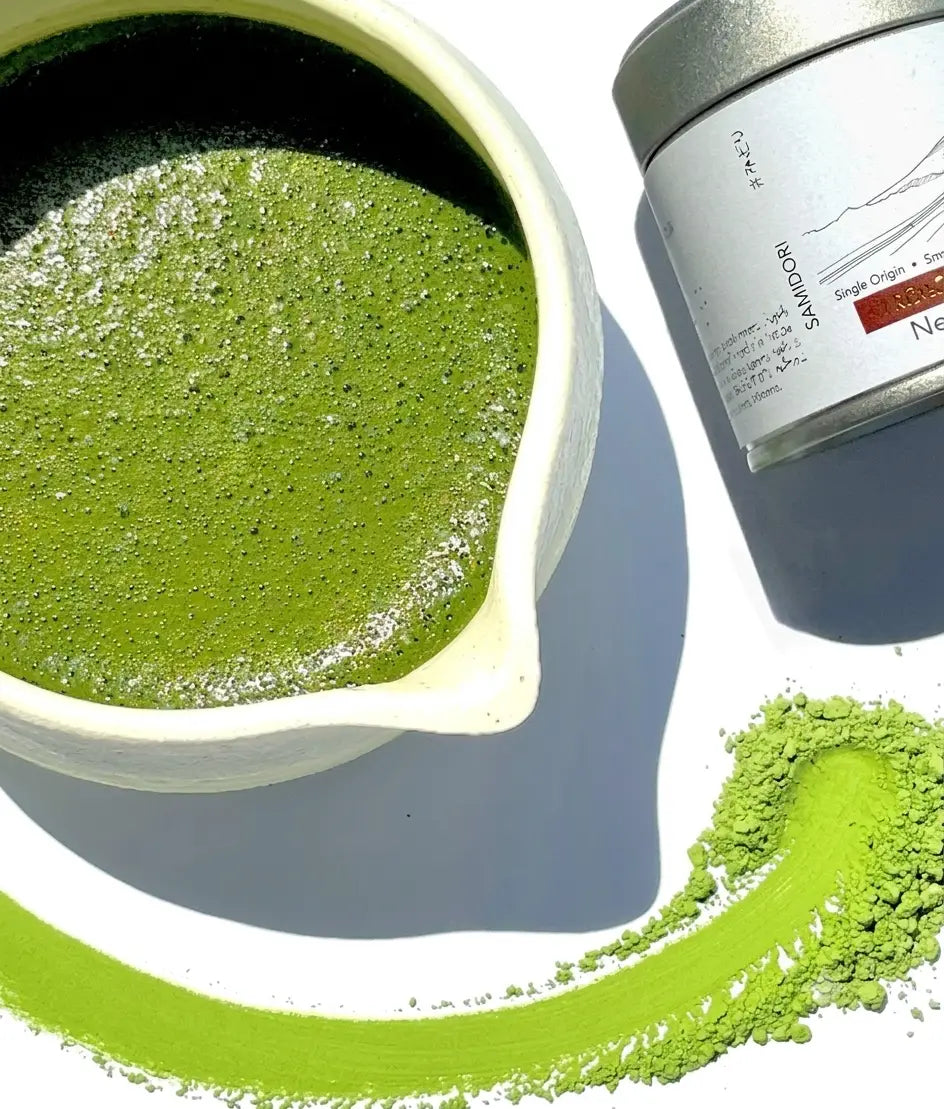
The vivid green color is itself a clue — it tracks with the same shade-growing that builds L-theanine.
Why shade-growing matters
L-theanine content isn't fixed by the plant alone — it's largely determined by how the plant is grown. Ceremonial-grade matcha is shade-grown for a minimum of three weeks before harvest, with coverings blocking most direct sunlight. Denied full sunlight, the plant produces less of the catechins responsible for bitterness and retains more L-theanine, which would otherwise convert into those compounds under normal sun exposure.
Timing compounds this further. First-harvest leaves — picked in spring, before the plant has spent its stored nutrients — carry the highest L-theanine concentrations of the year. Later harvests and unshaded leaves both carry meaningfully less.
Ceremonial grade vs culinary grade
Neither grade is "wrong" — they're built for different uses. But if the goal is the calm-focus effect specifically, the growing protocol behind ceremonial grade is what actually delivers it.
Who notices L-theanine most
The effect is most noticeable to people who are sensitive to the jitters or crash that plain caffeine can bring, or anyone looking for sustained focus over a longer stretch — writing, studying, or a work session — rather than a short, sharp burst of energy.
Ceremonial vs culinary — side by side
L-theanine, answered
Is L-theanine the same as caffeine?
No. They're separate compounds. Caffeine is the stimulant; L-theanine is an amino acid that moderates how that stimulant is absorbed and felt. Matcha naturally contains both together.
Does green tea have L-theanine too?
Yes, since it comes from the same plant. But green tea is steeped and the leaf is discarded, so only the L-theanine that dissolves into the water makes it into the cup. Matcha is consumed as a whole-leaf powder, so all of the leaf's L-theanine is included.
Why does shade-growing increase L-theanine?
Blocking direct sunlight slows the plant's conversion of L-theanine into catechins, the compounds responsible for bitterness. With less sunlight, more L-theanine stays intact in the leaf by harvest time.
Can you take L-theanine as a supplement instead?
Standalone L-theanine supplements exist and are commonly paired with caffeine tablets to mimic the effect. Matcha provides both compounds together naturally, in the same ratio the plant produces them, along with chlorophyll and other compounds a supplement wouldn't include.
How can I tell if a matcha is high in L-theanine?
Look for first-harvest, ceremonial-grade matcha with a stated shade-growing period of three or more weeks. A vivid, deep jade-green color and a smooth, naturally sweet taste rather than a sharply bitter one are both consistent with higher L-theanine content, though the growing details are the most reliable indicator.